we don't shame smart glasses wearers enough
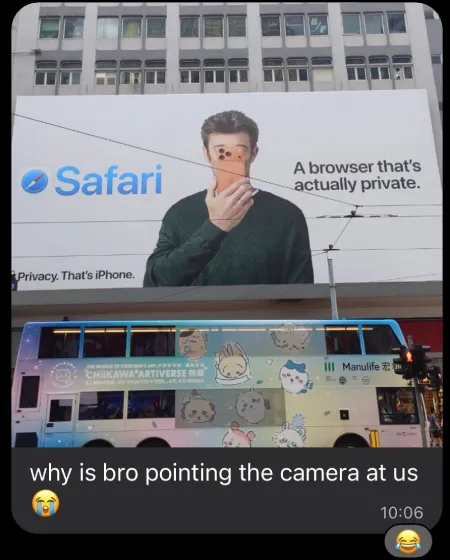
Wombat sent me the above picture: A physical ad by Apple on a big canvas. Pictured is a person hiding their face with their iPhone, but therefore actually pointing the camera at the people seeing the ad. It says: "Safari. A browser that's actually private." and "Privacy. That's iPhone."
It's accidentally perfectly demonstrating the limitations in current popular privacy discourse and movement: The fact that devices or software may claim to keep the users private, but not people in general, especially not the people the users point these devices at.
Privacy, as it is commonly practiced and advertised, is for the person inflicting the damage onto their surroundings, not their surroundings.
Privacy, in the mainstream, is seen as this highly personal, individualized thing; something you buy into, switch into, invest time becoming "good" at. Everyone is fending for themselves, arming up on their own. Your choices seem to reflect something about your values and how well you understand the topic.
The goalposts get moved fairly frequently: "Oh you still use that company? They aren't actually that good. Switch to the other one instead." "Wait, you think only using this browser extension and a VPN is enough? You are a dumb little child. If you don't use these more extreme measures, you might as well not try." It lends itself to a certain demographic cosplaying as state targets and playing evil hacker because they feel cool using Kali Linux.
Meanwhile, a lot of popular privacy content online is essentially a whole ad break, together with bad news about what Big Tech recently did that you can then reshare with people to get upset about together, driving up engagement and that's it. It doesn't tell you why something is bad, what you can do to stop it, what rights you have, or other actionable steps besides "Switch if you can, I guess. But use my sign-up code and/or subscribe to the newsletter.". At other times, it's just empty complaining - what should be, could be, maybe is illegal, but no drive to find out, confirm, or what initiatives and ways exist to make it so.
The general message often seems to be: If you don't conform to what is currently being recommended by this or that privacy community, you shouldn't complain. You did it to yourself! You chose to use all that and not switch. Therefore, you invited it and were okay with this happening to you. Or otherwise: It is all futile.
I'm not going to pretend people do not have any agency in what products they use, and I am always in favor of people switching to less bad alternatives. Otherwise, I would not have no accounts on social media platforms and not use Linux or Tuta, for example. However, it is also incredibly stupid to pretend the change towards better alternatives is always effortless and affordable, or that competitors are always comparable or even exist.
Even Apple has spotted the potential goldmine of privacy a while ago, not just to set themselves apart from data-hungry competitor Google, but also recognizing that in our current society, privacy is a privilege and is becoming one more and more. Knowing the "right" products and being able to buy into them is a flex, it sets you apart. You can feel like you are treating yourself, like you are investing into a good thing. Understanding privacy as a right, being informed about what tech companies do, and what effects it has or can have on your life and the lives of others and then also doing something about it is a highly intellectual affair that many of us in the privacy space underestimate. It perfectly fits to Apple's health-conscious, society-conscious, upper class brand image.
We tend to underestimate how costly it can really be to no longer want to support certain companies, be in control of our own data, and no longer be the product being sold. From your own VPS to domains and paying for traffic, YubiKeys etc., a new PC that is more compatible with a Linux distro, an iPhone (or if you can, replacing whatever you have with a phone that can run GrapheneOS), the much higher priced plan on other email suite providers than it is on Google, paying for search engines, paying for a reputable VPN provider, and so on.
Do you have to do all that? No. Lots of privacy-respecting stuff is FOSS, and not everyone has the same need for privacy (compare the average Joe to an investigative journalist!). But not all of it is free; a lot of products in the privacy space might have a free tier, but their other tiers simply offer more (alleged) privacy. That doesn't even touch the costs of just not playing the game - not having a smartphone, not having social media, and so on.
All of it leaves out that you can go to the most extreme measures and are still victim of the privacy practices of others.
The best privacy-conscious service can still leak your data. Your devices can still become compromised. Your family members, friends, partner(s), coworkers and the like still have pictures of you on their phone which sync to the cloud, still chat with you on their data-hungry devices, still put information about you in an LLM or nudify a picture of you, still navigate to your address with Google Maps, and post your group selfie on Instagram or Facebook. When you enter their homes, you are in the presence of home assistants like Alexa, or their indoor pet cameras.
When you walk outside, you are increasingly filmed with strangers' doorbell Ring cameras. You sit in restaurants and cafés, and walk through the city, while being in the background of some YouTube videos and TikTok dances. People film and post you without your knowledge or consent to gain internet likes because you looked odd. Cars have more and more sensors and cameras for both the people inside and the world outside. Cities everywhere are investing into AI-assisted camera surveillance and make contracts with Palantir and Flock. More and more law enforcement is wearing body cams (for both good and bad reasons).
And, of course, you got people walking around with smart glasses now!
Surveillance is fun when you're the one doing it; after all, we have always had people in our society that love being informers, block wardens and spies. Now, by appealing to the feeling of having control over others, documenting all our lives, having video proof of interactions and even more material to feed into LLMs for self-optimization, large corporations market their new surveillance systems for private use under the guise of individual security, productivity or entertainment, which ultimately undermines the security and freedom of us all.
Webaligo fittingly writes:
"The cost of comprehensive surveillance has fallen so far, so fast, that the central reason tyranny used to burn itself out - the sheer human expense of paying enough people to watch everyone else - has simply evaporated. The bottleneck is gone. You no longer need a nation of informers. You need a vendor contract."
This is where we need to come together, and aside from structural changes, make it personal. When someone buys and wears smart glasses, it should be made clear to them that they are considered a massive asshole committing a social fauxpas and are unwelcome in any space.
It doesn't even matter much that they are a mindless consumer following tech trends without question; they wouldn't be alone in that, and that is not a crime. But: They are trading the rights of others for the chance at cosplaying a Sci-Fi movie until the novelty wears off. They try to flex with an expensive product with an inherent power imbalance between wearer and environment to compensate for something. They choose to invest a lot of money into ethically untenable companies for a product that is entirely optional and does not add any value. After all, we have object and facial recognition capabilities already built into our fucking brains.
They are fine with being seen as a creep who is filming and taking pictures of people without their consent, even children, and adding to the general constant surveillance of us all. These glasses are also vulnerable to attacks, and I'm sure if nudifier apps are already a thing now, it won't take long for live nudification on the glasses. Them wearing smart glasses is in solidarity with the panopticon we are in, with all the pranksters, pickup artist, street interviewers and other online scum who embarrass, scare and harass strangers (especially women) to generate views on social media, and all the disgusting people who generate nudes of people non-consensually via AI.
All that is its main draw, its main purpose, its main user group. Smart glasses wearers can tell people all they want that they are not like that, but no one should believe that. They rely on people not being able to spot the glasses, not knowing what the consequences are, or not knowing what the recording light is for, and their reassurances are worthless as other wearers modify their glasses so the recording light is always off. Meta is also currently testing a prototype feature called "super sensing" where the glasses would always record, all day - that's the goal. There is no justification for wanting to have the features it has if you are not morally bankrupt.
You have to understand that the wearers are playing a significant part in not only gathering faces in motion (for companies like Clearview.AI), but also training spatial data for AI to act in three-dimensional space - eye, head and body movements, hand-eye-coordination and more. This, undoubtedly, will not only be used in autonomous AI weapons, but any context where bots are supposed to replace humans negatively.
There is only so much shit you can gather underneath your shoes before you can no longer blame everyone else for thinking you're the asshole; or rather, glasshole.
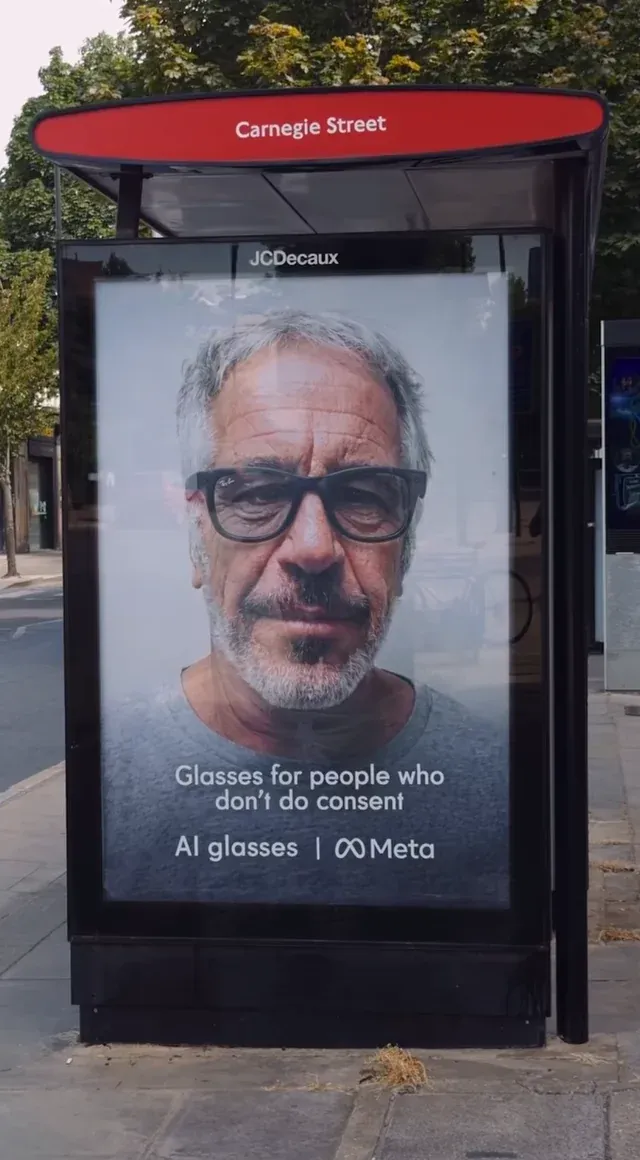
So don't let them off the hook about owning the pervert glasses. Don't let it go. Ask them if they're recording, or better, ask them to take them off. Tell them being a walking CCTV for daddy Zuckerberg isn't a personality and no one is impressed about another tech bro who can't experience reality and has to dehumanize everyone around them to feel good. Kick them out.
Published