#LiegendDemo - protesting for ME/CFS treatment & visibility
Today, I attended a protest for the visibility of ME/CFS sufferers.
ME/CFS is short for Myalgic encephalomyelitis/chronic fatigue syndrome; it is a chronic illness characterized by extreme fatigue that doesn't improve with rest, along with sleep issues, dizziness, muscle and joint pain, cognitive difficulties, extreme sensitivity to stimuli, and more. There is significant overlap with what is often referred to as "Long Covid" or "Post Covid", leading to speculation that they're one and the same. It is estimated that 1.5 Million people are affected in Germany alone, with around 40 Million estimated worldwide. One day, it could be you.
The exact cause is still being investigated, but it is most often associated with a viral infection (Covid, Epstein-Barr, etc.), and while symptoms can sometimes be managed, a full recovery is very rare. There is currently no known treatment or cure, and diagnostic criteria are still being developed after all this time (50 years since the WHO has acknowledged it!), which makes getting a diagnosis hard. There is stigma around the illness, with doctors dismissing symptoms entirely or blaming it on mental illness or laziness, inappropriately trying to force sufferers to overexert themselves, worsening their symptoms. This is aided by the fact that ME/CFS is often not taught in medical degrees.
This group of patients is especially vulnerable, because advocating for themselves takes so much energy they don't have. Many of them can not even get out of bed or do any strenuous mental tasks, or they have to spend the little energy they have with the bare minimum to survive and then have none left for their free time. They are frequently very isolated and lacking the support they need.
Any exertion can cause weeks of increased symptoms (post-exertional malaise). Years of their life are just gone, spent existing in bed in a dark room, unable to think clearly or to really move, having difficulty speaking, having difficulty processing and enduring sounds, touch, or light. The fatigue can become so bad that they are unable to even talk.
Their education, finances and careers suffer, they can no longer take care of themselves and their families or pets, they struggle with doctor's appointments or the paperwork required to receive assistance, disability benefits, etc. and often start to have other chronic illnesses like fibromyalgia, irritable bowel syndrome, postural orthostatic tachycardia syndrome (POTS) and more. It can affect both children and adults.
It's easy to forget they exist because they are not visible out in public and left behind in public discourse. To make them visible, people all across the country meet up to lie on the floor - this happened for the first time in 2023, and is still going strong in 2026.
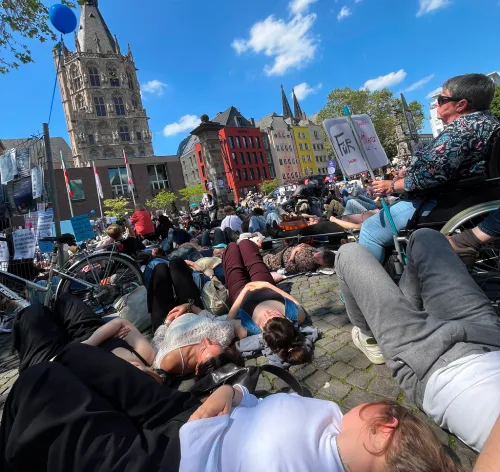

I don't have ME/CFS, but after a Covid infection, I struggled with orthostatic issues, post-viral tachycardia, and my chronic illnesses (Crohn's and Bechterew's disease) sometimes cause me intense fatigue as well; so I can relate a little to some parts of the illness, but I am lucky that my issues have treatments that helped (and some I could recover from). It was important to me to show up when they can't.
what we ask for
1. Dedicated funding for ME/CFS
Research funds must be specifically allocated to ME/CFS with PEM, rather than absorbed into broader post-infectious research categories. Otherwise, the disease risks being underfunded while still being treated politically as adequately addressed.
2. Priority for drugs and effective treatments
Prioritize the development of medications and clinically effective therapies, not only basic research or administrative structures.
3.Mandatory involvement of patient organizations
ME/CFS patient representatives with PEM expertise should be directly involved in planning and implementation. Past programs included people unfamiliar with the disease, resulting in research that overlooked core symptoms and legitimized unsuitable therapies.
4. Immediate funding for biomedical research
Concrete biomedical projects should receive funding without delay, not spending years building structures before supporting treatment-oriented research, despite already existing promising drug approaches.
5. Clear disease definitions, rigorous research standards and exclusion of unsuitable research approaches
Studies should use strict diagnostic criteria and focus on PEM as the defining symptom. Many previous studies examined general fatigue rather than properly diagnosed ME/CFS, producing weak or misleading results. Research that ignores the biological, multisystem nature of ME/CFS should not be funded.
6. Legal and political safeguards
The so-called research decade should be backed by binding commitments rather than remaining a non-binding political initiative. Otherwise, funding and programs could be reduced or canceled after political changes.
7. Healthcare access, diagnostics, social support, and patient care, sustainable research infrastructure
Long-term structures such as specialized centers, biobanks, patient registries, and clinical trial networks should be established to support ongoing nationwide ME/CFS research.
8. Use existing research and strengthen international cooperation
Future work should build on existing ME/CFS findings and coordinate internationally to avoid redundant studies and accelerate progress.
resources
The International ME/CFS Awareness Day is on May 12th.
Donate to the ME/CFS Research Foundation
Read what people affected by ME/CFS say
18 Minute Short Documentary on YouTube, English Subtitles
🇩🇪 Doku: ME/CFS: Keine Kraft mehr
🇩🇪 ME/CFS sufferer in Austria making use of assisted suicide program
🇩🇪 MECFS.de
🇩🇪 ME-Hilfe.de
🇩🇪 Fatigatio.de

Reply via email
Published