are disabilities and chronic illnesses 'cool' now?
On September 5, The Telegraph released the article “How having a disability became cool” by Poppy Coburn.
The by-line is:
“Young women, nicknamed ‘sickfluencers’, are turning chronic illness into a lifestyle trend and entrenching a culture of economic inactivity”
Quite venomous words already jumping out here. Attentive readers might notice it’s immediately insinuating that disabled people are lazy and choosing to lead this lifestyle voluntarily for fun. Awesome.
The article immediately opens with the odd observation that many people at trans marches and protests use walking sticks. The transphobia is apparent throughout the article, but already starts here. That’s no coincidence: As a UK paper, they welcome that. To them, being trans is just another thing people make up as an excuse and for attention, so of course it can’t be left out in an article about how disabled people increasingly refuse to be invisible and actually feel confident enough to ask for support and accommodations, even fighting the stigmatization of walking sticks among young people.
Further on, it says
“Disability is changing. To many, it is no longer an adversity to overcome, but a social identity akin to one’s sexuality, gender, or race; an immutable reality to be celebrated by the subject and accommodated by the rest of us.”
I find it so disrespectful by able-bodied, not chronically ill people to keep pushing this idea that disability is something to be overcome. It puts the onus on the disabled or sick person to somehow change or cure their disability or illness, instead of on their environment to accommodate different needs.
It goes hand-in-hand with seeing us as merely people to be “inspired” by, and for this inspiration porn to be created, you make disabled and chronically ill people struggle and beg and settle for less and forego accommodations, just to go “Wow, you’re so strong for that.” and “At least you’re not letting it define your life.”, the latter being reserved for people who are lucky enough to function well enough to pass as healthy.
Because people who dare to talk about it, to show it, to use accommodations like canes or more home office days or extra time for assignments? They’re not trying hard enough to be “normal” and “use” their disability for advantages and let it dEfiNe tHeiR liFe. You put us in this weird spot where we aren’t allowed to be utterly sad, bitter and angry about our fate, but we are not allowed to embrace it and find happiness in it either.
Realistically, what is “overcoming” in this context supposed to mean? The vast majority of chronically ill and disabled people already try all they can to not worsen their condition; they go to doctor’s appointments if they can afford so, they get their tests done and take medication if they can pay for it and get it covered (if there is one for their condition, and they are taken seriously by enough to get it), they do physical or psychological therapy, limit their foods or their activities, and more. I do so many things in my life to keep my brain and body as intact as possible that healthy people don’t have to, and it’s like a second job; yet I will never “overcome” this.
I’m in disbelief at the fact that people like Coburn do not seem to understand the finality of chronic illnesses and disability, probably because the thought that you could just become sick and never get better deeply scares them. But that’s how it is!
Disability and chronic illnesses will most likely remain part of the person’s life until they die. Depending on what it is, it can influence anything from the way you dress to the activities you can partake in, your mobility, the foods you can eat, your social status, the jobs you can do, the income you have, and more. In what world would that not significantly impact your lifestyle, and why would we wanna hide that it does? No longer having legs to walk with, or no longer having parts of your colon, or being bedbound, or having cognitive issues is an immutable reality. What else would it be? We can change the names in the diagnostic criteria, but the symptoms remain and are a part of me just like race and gender.
The article goes on to describe the strong increase in disability numbers, suggesting that the diagnostic criteria are too broad and hard to prove if it’s not literally a physical disability. It’s funny that Covid, an event that left a lot of people disabled, is not mentioned more prominently in this than just vaguely referring to “the pandemic” for timeline reasons. No, it has to be all those fakers with their little sadness they call depression, or the people who pretend to have POTS, apparently.
Listen up: I’ve had a Covid infection so bad, I had POTS symptoms for 4 months after and also had to take beta blockers for it. The only reason I wasn’t diagnosed with it was that it went away in time, and symptoms have to persist for at least 6 months, I was told. And the longer it went on, the more scared I was that this could be permanent. There was no “overcoming” I could do. All I could do was wait and hope my body gets it together, and I was lucky. And now people like Coburn are surprised that after Covid (which is still going on!) we have a strong increase of people with POTS? I didn’t even bring it up myself; my doctor mentioned it and never made it seem like it was a controversial or illegitimate illness, like the rest of the article does.
What follows is:
“But, were they not decked out in the accessories of their disease, it would be impossible to perceive the conditions they consider to be so central to their interaction with the world.”
Okay, and? What is the problem? I fail to see what’s the issue. Lots of disabilities and chronic illnesses are invisible. I have Crohn’s disease and Bechterew’s disease. I don’t yet have a stoma, but if I had, it and its bag would be underneath my clothes. And because I am young and on treatment, I don’t walk around with a fused, curved spine yet, and hopefully never will. If you catch degenerative diseases early and are lucky with successful treatment, it means we can slow the process and give people a higher quality of life, which often means it’s not visible. It being not visible doesn’t mean it’s not real, or symptoms don’t persist, or there isn’t treatment for it that the person goes through and wants to talk about.
“* […]you’ll be bombarded with artfully curated pastel info-graphics (“Seven symptoms I didn’t realise were Pots”), beautiful women with slicked-back hair sharing their Pots journey (“hi life update: I have a chronic illness!”), pink wheelchairs and walking sticks, compression socks embroidered with flowers and bold messages against medical misogyny […]*”
This is presented as a negative thing. Oh no, disabled and chronically ill wanna inform people about their conditions, and make art about it, and feel beautiful, and make sterile depressing looking medical aids beautiful and match their style! How terrible! Everyone, please show off your glamorous life online and embellish it… but not you, with your disgusting wheelchair!
The article thankfully acknowledges the fact that more women than men suffer from chronic illnesses and that women struggle with being taken seriously by doctors. Despite that, the entire article feels incredibly misogynistic, because it never successfully connects the isolating and painful experience of that with the behavior that is weirdly critiqued; the tone is more like “Young women and their hysteria and need for attention, am I right?! Just like when girls used their period to get out of gym class!!!”
Rightfully, Coburn mentions the darker side of social media illness content: Snakeoil salesmen preying on the helpless who have run out of options or hope. Those exist and deserve to be called out. I just find it weird to pretend a disabled person offering compression socks in their shop is somehow on the same level to what I have seen a lot more of: People selling courses, cookbooks, supplements etc., because everything can suddenly be cured by a healthy gut biome, FODMAP or carnivore diet, 3 capsules of turmeric in your rectum a day, or homeopathy.
I’m not saying the call never comes from inside the house. Disabled and sick people can prey on each other and economic circumstances many of us have might edge people closer to it. However, the vast majority of scammers I have seen were healthy people who just got into that because we are easy targets. They slide into your DMs, your emails (even here!), they join patient groups on Reddit, Discord, and Facebook just to advertise their shit. I don’t know what that has to do with “sickfluencers” being open about their life online.
“She describes a “hyper-awareness of physical symptoms like fatigue and a racing heart” from patients who visit her seeking an explanation for their pain, with an expectation that there will be a single, incontrovertible diagnosis. Often though, she says, it is more likely that factors such as “a lack of sleep and exercise and a poor diet” are causing the patient’s symptoms, and these can be resolved with minimal medical intervention.”
I find this to be so incredibly dismissive. A lot has to be ruled out first for POTS to be considered, and there’s literally a table angling your body to see when your body abnormally responds to being upright. Lack of exercise, sleep and poor diet were not the case for me and my post-viral tachycardia. It’s not normal for your heart rate to consistently shoot up to between 120-150bpm just for sitting up in bed or slowly walking into the kitchen. Talk about hyper-aware when you feel like your heart is gonna jump out of your chest. It’s like going to the ER and having everything dismissed via “anxiety”. It fucking sucks, and I wish people lost their job for fabricating such non-sense proudly in a newspaper.
“For many observers, the phenomenon is a direct consequence of the way in which normal facets of life have become medicalised. You’re not forgetful, you have brain fog. You’re not feeling low, you’re depressed. You don’t dislike crowds, you’re suffering from agoraphobia. You’re not excited, you’re in a manic episode. The entire range of human emotions can be tidily sorted into a diagnostic box.”
Literally none of these have any significant overlap with each other and wouldn’t be diagnosed as such. The threshold for all of these is that it causes significant impairment in your everyday life. Simple forgetfulness might be annoying, but isn’t literally damaging your life and leading you to almost cause a car accident. Same with feeling low or uncomfortable in crowds; no one calls themselves agoraphobic for hating crowds! It’s the inability to leave the house at all that impairs people’s lives the most. I can’t even put into words how horribly ignorant this paragraph is. It’s like putting zero effort into researching just to be able to complain that everyone is sick nowadays. It shows zero personal experience too, which makes me wonder where the authority even comes from to speak on all this.
“Young women are also more likely to get caught up in “social contagion” – the spontaneous spread of behaviours or emotions previously observed by sociologists in “outbreaks” of bulimia, self-harm and transgender ideology. What may have otherwise been transitory feelings are seized upon and obsessed over until they form a central pillar of a person’s identity. A chronic-illness influencer won’t want to get “better” any more than a female-bodied transgender person would want to re-identify with their sex.”
I am at a loss for words, really. Chronic illness havers do not get better because that’s what makes it chronic. Most trans people have tried anything they can conceive of to not to be trans and had to fight intense denial and fear before taking that step - because it involves horribly long waiting lists, humiliating therapy sessions in which it is normalized to ask dehumanizing questions about their genitals, sexual life and porn preferences, as well as medical discrimination, job discrimination, the potential loss of family, friends and partner, and the risk to be murdered. But sure, they choose that for fun. Asshat.
“When my mother was a girl, she feigned unbearable abdominal pain to dodge a minorly unpleasant task. She kept the act up for so long that when a doctor diagnosed her with appendicitis, she failed to break character – and even when she was prepared for surgery – she couldn’t bring herself to confess. And so, whenever I’d swear blindly I was too unwell to go into class on a Monday morning, she’d remind me of the small scar beneath her stomach.”
I fail to see how the author’s mum being a horrible liar is a good reason to apply that mindset to strangers she only sees online and never actually speaks to. Maybe stop this weird projection?
Of course, an article like that cannot survive without mentioning increased diagnoses of autism, the absolute favorite topic for people who pretend increased rates of any diagnosis is a bunch of bullshit.
You can think what you want about the integration of “Aspergers” into ASD, but to pretend it doesn’t make sense that more women get diagnosed late in life now because only boys used to be considered and autism can look different in girls and be missed is simply illogical. It’s fearmongering for absolutely no reason. What’s the threat here, really? People online now get diagnosed at 30+ and make a video about it and nothing else changes in their life, as many of them do not need or cannot get accommodations because most of them are for the school years. What is the effect on you or society as a whole?
“It would require incredibly bad luck indeed for so many of these women to be afflicted by so many completely different illnesses with totally different medical causes. But luck seems to have nothing to do with it. There is a wealth of medical evidence that disorders with no proven pathology overlap. In many of these cases, if the cause is medical, it is strictly psychosomatic. And if it is not medical, it is likely to be based on identity: the desire to increase one’s status through suffering, or to enjoy a larger community of supporters.”
No, it’s just called comorbidities. My Crohn’s disease is actually one of the symptoms of my Bechterew’s disease as both patient groups have a significant overlap, and having one diagnosis helped diagnose the other. Lots of people with my diseases also have had depression in the past, and abusive childhood, allergies, and things like PMOS or endometriosis. All of these are real; the body is simply a system, and when my diseases (and its inflammation) were uncontrolled, everything else was worse as well. In general, we don’t fully understand all illnesses yet, especially ones that tend to happen after viral infections (like ME/CFS) or ones that are autoimmune. Why can’t we have reputable doctors for these discussions, instead of a journalist with an agenda?
“The truth is that it is not harmless to allow a generation of girls to convince themselves they are sick without good reason. Nearly one in 10 people of working age is now claiming a sickness or disability benefit, and the number of children receiving disability benefits has doubled in the past decade.”
No. The truth is that people like the author are scared of disability and chronic illness, and scared of the possibility that the source of it all could be environmental or systemic; that would require a lot of change that likely won't come, and it’s easier to pretend it’s all in our heads and we can will ourselves out of it than look the likely facts in the eye.
“All of the major political parties have acknowledged that disability-related welfare costs are unsustainable, with Reform vowing to compel a quarter of a million people back into work, saving taxpayers up to £50bn, if it forms the next government. Overdiagnosis of minor issues that 20 years ago would have resolved on their own can be ruinously costly. And it’s not just immediate welfare costs that are placing a strain on public finances. The number of school children receiving SEN (Special Educational Needs) support has soared since the pandemic, rising from one million in 2018-19 to 1.3 million in 2025-26, straining school budgets to the limit. […] As is also the case with dogmatic aspects of transgender ideology, sickness-as-identity politics is especially dangerous for children. We are creating a cohort of young people that is totally dependent either on doctors or activists for emotional support, and broader society for economic support.”
Yes, people who need treatment rely on doctors and society for life. I don't understand why transgender people are always targeted in these discussions with this aspect, because I, or diabetics, or people with a pacemaker also are dependent on doctors and society for life.
Moreso, talking about the costs of supporting disabled lives is incredibly icky. Austerity politics in the UK have killed tens of thousands of disabled people since 2010.
There's this one Nazi propaganda poster/magazine cover that just never leaves me. I probably think about it multiple times a week, especially with where Germany is headed, but also because I'm a rather expensive patient and will continue to be so for life.
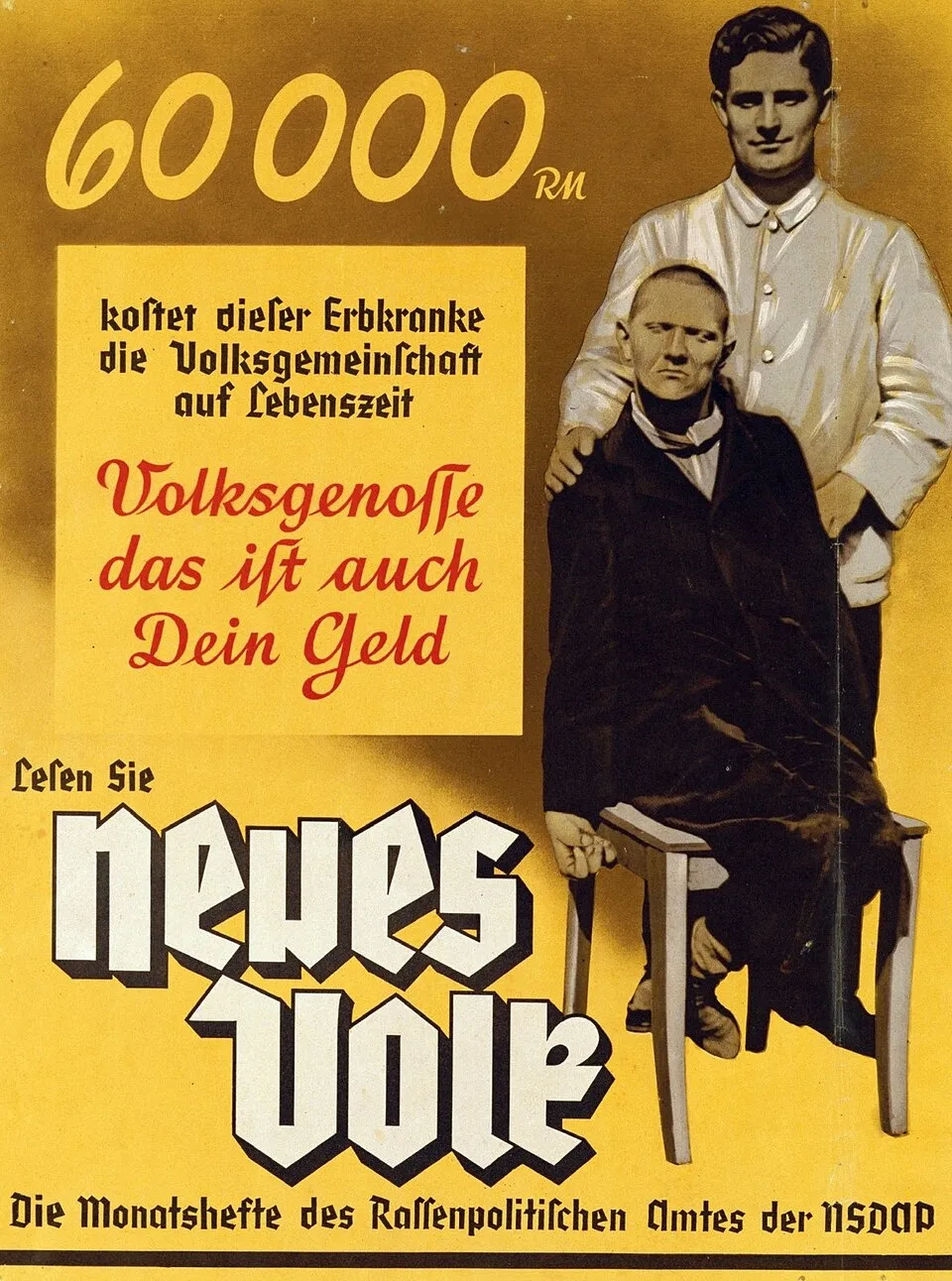
Loosely translated, it says:
"60.000 RM [currency back then] costs us this genetically diseased person for the rest of their life. Fellow comrade, that's also your money."
It's a poster in favor of eugenics because sick people cost society too much. It's supposed to tell you that you can save money by being in favor of culling the sick.
Poppy Coburn therefore, in a completely non-chalant way, spread Nazi rhetoric in The Telegraph, with apparently little to no pushback. To her, we are spectacles to be gawked at, people who merely exist on social media like a trend shoved down her throat, and only relevant enough to write ragebait articles about in which eugenicist views are normalized. What a disgusting way to make money. You should be ashamed of yourself.
Published